Article at a Glance:
Early low voltage design for Division 27 (communications) and Division 28 (security) prevents costly construction changes. By coordinating WiFi, structured cabling, AV, and security before building begins, projects avoid expensive retrofits, waste, and design conflicts—like fixing inadequate WiFi or mitigating AV noise issues through shared walls.
Key Takeaways
Reduces Costs: Early planning prevents high retrofitting fees after walls are closed.
Prevents Waste: Peer reviews catch critical spatial, acoustic, and technical oversights early.
Delivers Thorough Documentation: Ensures clarity with floor plans, riser diagrams, rack elevations, and detail drawings.
Provides End-to-End Oversight: Spans schematic design, procurement, and construction administration to match intended outcomes.
Proven Expertise: NTI’s approach (Planning Before Building™) relies on thousands of successful projects to lower risk and ensure seamless tech integration from day one.
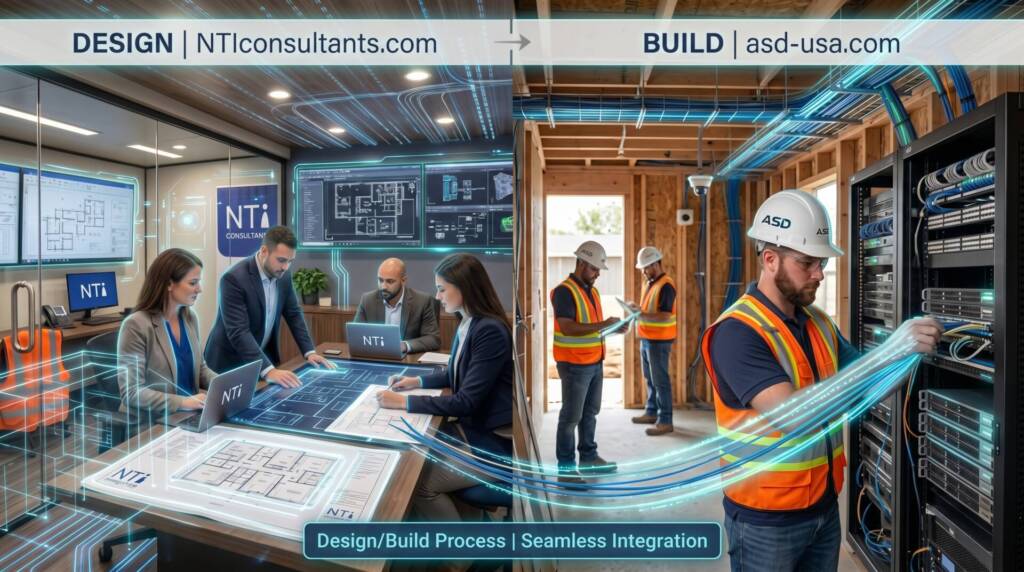
The importance of a low voltage design is often underestimated. An excellent design for the Division 27 & 28 systems is a critical component of a successful commercial project. And the company employed to provide that Design is the key to starting your project off right.
The NTI suite of services begins with the concept of the project. We offer consulting services during concept or schematic Design to advise on systems and budgets. We develop a design for the project by delivering milestone documentation throughout the design process, coordinating with the rest of the design team. We offer procurement management to manage an RFP process of selecting a firm for the build-out. And once we have delivered a 100% CD set, most of our projects include construction administration services to confirm our design intent. Optionally as requested, we will oversee the implementation of the systems.
NTI typically works on projects which use the design-bid-build project delivery method (as described above). This process remains the most widely used project delivery method in the United States (versus a design-build approach), according to a June 2018 study conducted by Fails Management Institute (FMI).
Design-Bid-Build and Design-Build are the two traditional methods an owner can use to complete a project. Either alternative works very well as long as there is well thought out Design from which to build out the technology.
According to the FMI study, Design-Build projects have been growing as a project delivery method over the past 30 years. The study predicts that by 2021 approximately 44% will be using the Design-Bid approach, with 56% following the design-bid-build approach.
In 2018, following a decade of proven success, NTI caught the attention of Automated Systems Design (ASD®). Their strategic acquisition bridged the gap between the drafting board and the construction site, bringing together NTI (nticonsultants.com) and ASD® (asd-usa.com) to deliver complete low-voltage technology solutions.
Since June 2018, their combined team of certified professionals (RCDD, CTS, CTS-D, PMP) provides end-to-end Division 27 & 28 commercial system services. NTI leads the technology Design (“Lane One” of ASD®‘s framework), while ASD® handles the Build, Deploy, and Support operations.
The Quality of the Design is Key to Success
Design sets are not all created equal. An excellent final construction set for Division 27 & 28 systems should be well-documented with notes and comments for all systems in scope, complete with room layouts, riser diagrams, equipment rack elevations, floor plans, detail sheets, and typical room layouts where applicable.
Consider an NTI conference center renovation project to illustrate how all designs are not equal. NTI was called in after construction began to design an upgrade to the WiFi system. The design team did not include a technology design consultant. Once under construction, the client realized that the WiFi was inadequate for the renovated conference center, now in the construction phase. Our client explained that WiFi was overlooked during the planning and design phases of the project. NTI was hired to provide a solution that would not involve destroying the already completed walls. We did precisely that; however, the cost of implementing a design after the construction had commenced was avoidable and unnecessary.
Even when all systems are addressed early, there can be problems depending on who provides the Design. NTI once provided the cabling infrastructure and security system design for a new high rise mixed-use (hotel/residential) project. We performed a peer review of the proposed AV systems design for the upscale residential units during the design phase. We found that the proposed “very high-end” AV systems would have created severe sound/noise intrusion issues between the residences’ common walls. The importance of appreciating the effect of the high-end systems was missed. With NTI’s redesign right-sizing the systems, the owner saved hundreds of thousands of dollars.
There is always a risk of unexpected technology issues during the project, so the company’s quality and the service they provide are a significant benefit for the owner. Without an owner’s advocate for the technology on the team who fully understands the importance of a complete design, these unexpected issues can become problems. If NTI is on the project, these issues become opportunities for us to save the project’s owner significant money. Our proactive approach and knowledge of technology design seek to identify potential problems before they happen. Our approach eliminates or corrects issues before they become costly for the owner. We have numerous projects where we saved more than our design fees because we avoided or solved an unexpected problem.
NTI is diligent in providing our services for a lump sum fee, without asking for additional services for minor changes. We are proud that our clients know that unless there are changes outside of our project’s proposal/contract, NTI will not request additional services fees. Owners certainly appreciate this approach compared to the opposite method of routinely delivering service proposals throughout the project. This also helps explain why the proposal with the lowest design fees is not necessarily the owner’s best value.
NTI has enjoyed consistent growth, nearly exclusively driven by returning clients and new clients referred to us by an existing client. We consider this to be evidence that the NTI approach works well. Most of our new projects are from returning clients, and our new clients are referred by an existing client. Those new clients often return after a first experience, subsequently delivering a 2nd, 3rd, or 4th project. Many of our architect clients have hired NTI dozens of times. We have owner clients who dictate that NTI be on the architect’s team even before the architect is selected.
When the owner decides on a Design-Bid-Build approach, the project is highly likely to require a technology consultant, such as NTI. Most of NTI’s nearly 1,400 projects are Design-Bid-Build projects, but NTI is no stranger to Design-Build projects. We’ve worked on quite a few over the years, including The Crawford at Denver Union Station and the majestic Marriott Marquis in Washington DC, with over 1 million GSF under roof.
Since NTI became part of the ASD family, we have started providing our design services for more design-build projects. We expect that we will continue to grow our portfolio of design-bid-build projects. We further anticipate building and growing our portfolio of design-build projects as well.
NTI trademarked the term, Planning Before Building because we have always known the importance of an excellent low voltage design. As we look forward to providing design services for projects this year and in years to come, we continue in that belief whether the project is a design-bid-build or a design-build project.
Frequently Asked Questions:
What is low voltage design?
Low voltage design is the planning and engineering of a building’s communications, technology and security systems. In construction specifications these fall under Division 27 (communications) and Division 28 (electronic safety and security). Typical systems include structured cabling, WiFi, audio-visual (AV), access control and video surveillance.
Why is low voltage design important for commercial projects?
A professional low voltage design makes sure technology systems are coordinated with the architecture before construction starts. Without one, problems like weak WiFi coverage or poorly placed AV equipment often show up mid-construction, when fixes are expensive and can damage finished work.
When should a technology consultant be brought onto a project?
As early as possible, ideally during the concept and schematic design phases. Early involvement lets the consultant coordinate with architects and engineers, plan pathways and spaces for equipment, and keep technology costs predictable.
Does low voltage design matter for design-build projects?
Yes. Whether a project uses design-bid-build or design-build delivery, a dedicated low voltage design still defines the requirements, makes the work biddable and gives everyone a standard to check the installation against.
What should low voltage construction documents include?
Complete documents should include floor plans, riser diagrams, equipment rack elevations, room layouts, typical room details and system notes. Detailed drawings like these reduce change orders and help contractors install systems the way they were designed.
What does NTI Consultants provide?
NTI provides independent low voltage and technology consulting, from concept design through procurement, RFP management and construction administration. Its Planning Before Building™ approach has supported nearly 1,400 projects, including the Marriott Marquis in Washington, DC.