


Article at a Glance:
The short answer is that luxury guests expect technology to work the way it does at home, everywhere on the property, without ever having to think about it. The best hotel technology is the kind nobody notices. The TV recognizes the guest’s streaming account. The Wi-Fi connects easily and follows them from the room to the pool. The room-service tray disappears from the hallway before anyone has to call about it.
Delivering a superior experience is not an accident. It starts with decisions made long before opening day: verifying that cabling works as designed throughout the hotel, making certain the hotel network is adequate for both guests and staff, planning for the pathways for wireless access points and CCTV cameras, and determining whether the property’s amenities are properly supported by the infrastructure and technology systems. For luxury properties, amenities often include ballrooms, meeting rooms, fine dining, lounges, spa, pool deck, a rooftop venue, parking, or golf clubhouse.
Luxury travel remains one of the most attractive segments for both guests and investors, and the operators of those properties are clear about what sets them apart. At this year’s Lodging Conference in Phoenix, a panel on the luxury market agreed that the guest experience drives the rate, not the finishes. As Enseo’s David Goldstone put it, “it’s not how much marble you have in the lobby.”
The same panel named high-quality technology as one of the clearest ways a luxury property can stand out. CoralTree Hospitality’s Tom Luersen pointed out that remote luxury resorts need reliable Wi-Fi, and so do places guests don’t always think of as “the hotel,” like the golf course and the parking garage. Valencia Collection’s David Miller made the comparison every guest already makes: Wi-Fi works perfectly at home, so it needs to work perfectly at the hotel, too.
That comparison is the real standard. A guest paying a luxury rate has a mesh network, a smart TV and a video doorbell at home. They aren’t impressed by technology for its own sake, but they notice right away when the hotel falls short of their living room. Meeting that standard is less about adding features and more about getting the foundation right.
The guestroom TV is a good example of where that foundation is heading. Marriott International and LG Electronics have developed a cloud-based guestroom entertainment and technology platform, now in a pilot at 40 Marriott hotels in the U.S. and Canada before a possible wider rollout. One screen brings together live TV, the guest’s own streaming services, free streaming channels, hotel information and room functions.
The guest sees a simpler TV. The hotel team gets something just as valuable: the ability to check the health and status of every TV in a room, a property or an entire brand from one place, so problems are found and fixed before a guest has to report them. Because the platform runs in the cloud, new features can be added without replacing hardware. LG’s Jake Benner told Hotel Dive that “the bigger opportunity goes beyond entertainment.” Over time, the same TV could control lighting and temperature, report leaks and pass along sensor data about room conditions.
For owners and designers, the guestroom TV is no longer a standalone appliance. It is a networked device that should meet or exceed the guest’s in-room expectations, and provide business efficiencies for the hotel operator. The guestroom TV that delights guests at one hotel will frustrate them at another if the cabling and network behind it were not properly planned and designed.
Some of the most useful hotel technology is small enough to overlook. Hotel Dive recently profiled TrayAway, a 2.5-inch device the kitchen places on each room-service tray. When the guest is finished, one button press sends an alert over the hotel’s Wi-Fi, and staff pick up the tray in minutes instead of hours. The idea came from a founder who worked in Four Seasons food and beverage operations, and its strongest market so far is four- and five-star hotels. It has reached more than 300,000 hotel rooms.
Nobody books a luxury suite because of a tray tracker. But a guest does notice a hallway lined with half-eaten dinners, and a luxury guest is far more likely to mention it in a review. That is the pattern worth paying attention to: low-impact technology that removes a small annoyance, runs quietly in the background and asks nothing of the guest beyond a single tap.
Devices like these share something else. They ride on the hotel’s Wi-Fi. A tray button, a leak sensor, a smart thermostat, a digital door lock and a cloud-connected TV may all live in the same guestroom, and each one assumes the network will be there. Every new device added after opening is a bet that the wireless design left room for it.
Wi-Fi is the one system every guest uses and every other guest-facing technology depends on. In Hotel Management’s October issue, Enseo CEO Brian Gurley summed up the stakes: “Guests rarely notice when technology works perfectly, but they immediately notice when it doesn’t.” Other vendors in the same piece made the infrastructure case. Positron’s Pierre Trudeau called in-room connectivity the base for streaming, IPTV, mobile services, AI assistants and smart-room controls, and he recommended giving each guest a private network segment (a dedicated VLAN) kept apart from staff and device traffic.
Frictionless also means the guest connects once. Many hotels still make guests find the network, open a login page and type a room number and last name, sometimes again on every device and every day. Newer approaches such as Passpoint and OpenRoaming let a phone join the hotel network automatically and securely, the way it joins a cellular network, often through a profile in the brand’s loyalty app. Support for these depends on choosing access points and network systems that can handle them, which is a design decision, not something added at the front desk.
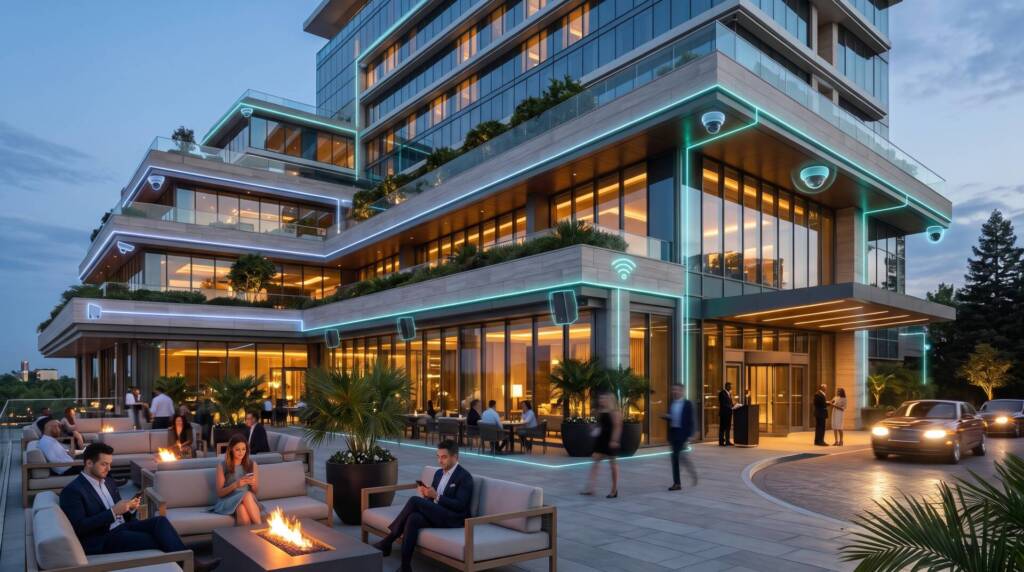
Then there are the guest amenities. Luxury guests expect the same connection in the meeting rooms, at the pool, on the beach, at the outdoor bar, on the golf course and in the parking garage. Those spaces need weather-rated outdoor access points built to resist sun, salt air and moisture, placed for crowds rather than distance, and managed on the same system as the indoor network so a guest can walk from the lobby to the pool deck without dropping a call. The hardware is rarely the expensive part. Trenching and running conduit to a pool cabana or a beach kiosk after the landscaping is finished is, which is why outdoor coverage belongs on the first site plan, not the punch list.
None of this technology is visible to the guest, and that is the point. Cloud TVs, tray buttons, room sensors and seamless Wi-Fi each look simple on their own. Together they add up to an experience that feels effortless only when the access points, cabling, network segments and outdoor pathways were planned together. That planning usually happens in schematic design, when the low-voltage consultant, architect, interior designer and MEP engineer agree on where the technology goes and what it needs, before the marble is chosen.
The next time you check into a luxury hotel, notice what you don’t have to do. You don’t ask for the Wi-Fi password, you don’t hunt for a remote that works, and you don’t step over a dinner tray in the hallway. The technology behind those moments costs far less than the lobby finishes if it is properly designed. And for a luxury guest it may matter more.

John Davis
FAQs
What technology do luxury hotel guests expect?
Luxury guests expect technology to work as well as it does at home, everywhere on the property. That means Wi-Fi that connects once and works from the guestroom to the pool, a TV that plays their own streaming accounts, and services that run quietly without a call to the front desk.
Why is Wi-Fi so important to the luxury guest experience?
Wi-Fi is the one system every guest uses, and nearly every other guest-facing technology depends on it. Streaming TV, mobile keys, smart-room controls and room-service tray buttons all assume the network will be there. If the Wi-Fi falls short, guests notice right away.
What is a cloud-based guestroom TV, and what does it need from the network?
A cloud-based TV brings live TV, the guest’s streaming services, hotel information and room controls onto one screen. It also lets hotel staff check every TV remotely. Because it runs over the hotel network rather than a stand-alone coax system, it needs well-planned guestroom cabling, a properly segmented network and enough capacity to stream video to every room at once.
How can a hotel provide reliable Wi-Fi at the pool, beach and other outdoor areas?
Outdoor areas need weather-rated access points that stand up to sun, salt air and moisture. They should be placed for crowds rather than distance and managed on the same system as the indoor network. The costly part is usually trenching and conduit, not the hardware, so outdoor coverage should be on the first site plan rather than added after landscaping.
When should a low-voltage technology consultant join a hotel project?
Ideally during schematic design, when the low-voltage consultant, architect, interior designer and MEP engineers can agree on where the technology goes and what it needs. Decisions made then about cabling, pathways, technology rooms and access point locations cost far less than changes made once walls are framed or finishes are installed.