


How can you future proof for rapidly evolving technology? We have heard that question for over 20 years. Technology has advanced at a rapid pace for the last 50 years with no evidence of slowing down. Even if money were not a consideration (it always is of course), absolute certainty cannot be guaranteed. However, we can and do design technology that utilizes the best available technologies to prepare for an unknown future, while considering the total cost of ownership (TCO) for owners. At NTI, we consider the term ‘future ready’ to be a far more accurate term.
Everyone remembers “the old tech” of their youth… before the arrival of a life-changing technology that soon after became part of our everyday life. If you were born 30 years ago, the life changing tech that you remember might be gaming or social media. If you are 40 years old, you remember a childhood without WiFi or cell phones, and the introduction of both. If you are as young as 50 years old, you are the same age as Microsoft and the personal computer. All of these technologies and many others are now part of our everyday lives and each of them rely on a low voltage structured cabling system.

Designing the structured cabling system to support foreseeable changes requires an in-depth understanding of the collective technology components. It also requires current knowledge which is achieved by remaining students of the industry. For example, there can be alternative ways to achieve an owner’s objective where either alternative will work. Each alternative may work well, but the comparative cost to implement may be considered too high at the time of the current project design to achieve the benefit which might be years ‘down the road’. This same analysis might be performed a few years later on a subsequent project and the other alternative might be chosen. Time may have lowered technology costs to employ the technology and the benefit would be secured immediately or shortly after opening day. PoE lighting and GPONs are examples of systems for which we have performed a cost/benefit analysis over the years for project owners.
It requires on-job-training and routine research to remain current with ever changing technologies. Expertise in our industry mandates remaining current with the systems covered in the (Construction Specification Institute) CSI MasterFormat Division 27 & 28 standard. Expertise is based on a thorough understanding of the OSI (Open Systems Interconnect) model shown below, which standardizes how computer networks communicate.
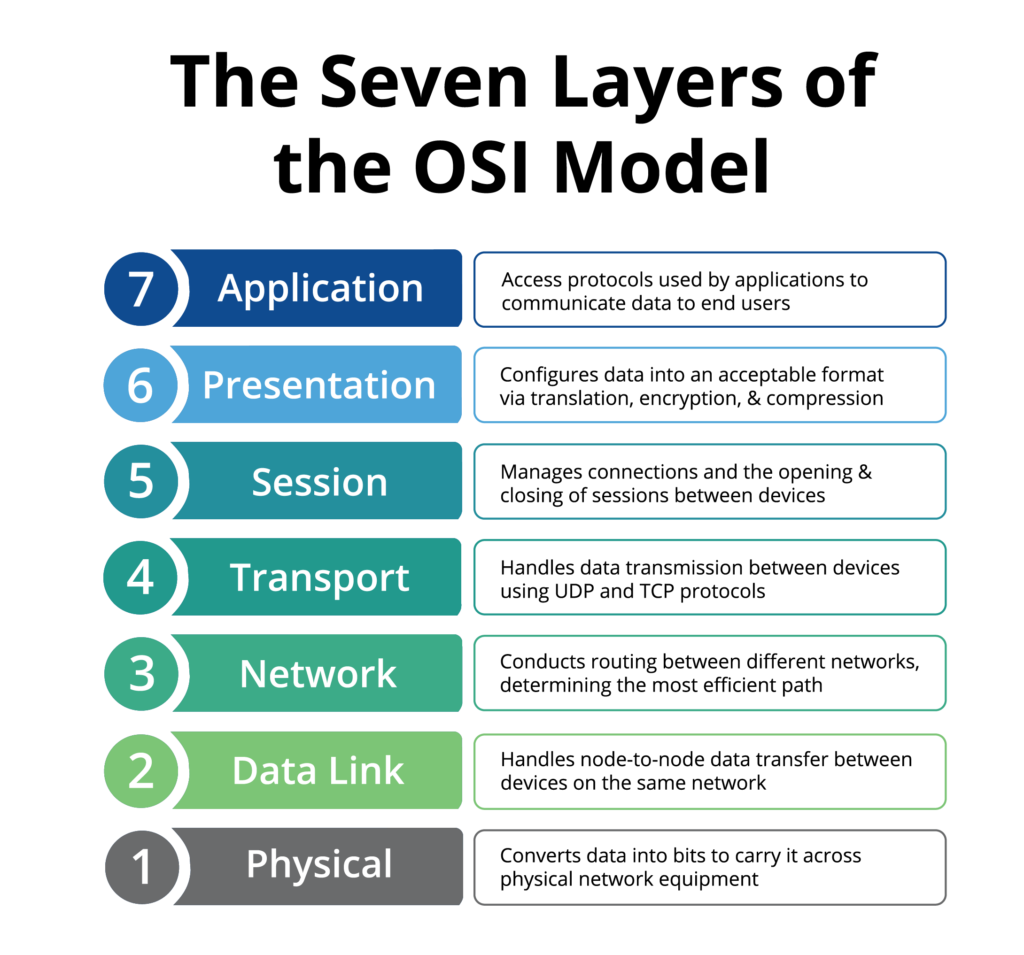
From a less technical perspective, a low voltage design for any commercial development will first need to include the IT/cabling infrastructure that supports every technology system. Then, the technology equipment and systems that manage the flow of all digital data, information or content needs to be defined and verified. Finally, the end point technologies that rely on the entire system need to be considered.
The structured cabling system includes:
1. The (Low Voltage) IT/cabling infrastructure
The cabling infrastructure runs throughout the building and/or across the campus. It needs to be designed early to account for the pathways (throughout the building) and spaces (where technology systems reside). In today’s world, the cable is either copper (category) or fiber optic. The evolution of Category cabling has been driven by humanity’s relentless demand for access and speed with their technology – translation… more bandwidth.
- Cat 3 – Arrived in the early 90’s and supported data transfer speeds, however it did not support full duplex connectivity.
- Cat 5 – Introduced in 1995, it was the first Ethernet cable to support 10/100 Mbps speeds and 100 MHz bandwidth.
- Cat 5e -The enhanced Cat 5 was introduced around Y2K and supported faster gigabit speeds (1 Gbps), improving performance over Cat 5 cable.
- Cat 6 – Introduced in 2001. Capable of supporting speeds of up to 1 Gbps over 100 meters and 10 Gbps over shorter distances (up to 55 meters).
- Cat 6A – Became the TIA (Telecommunication Industry Association) standard in 2008, and provides 1 Gbps up to 100 meters and speeds of 10 Gbps up to 100 meters. Its maximum bandwidth is 250 MHz. It is the current standard.
In some cases, higher speeds are desired or required – data centers for example. CAT 8 cable is employed because it can support up to 40 Gbps over a distance of 30 meters and operates at frequencies up to 2000 MHz.
Fiber optic cable offers 100 Mbps to 10 Gbps for multimode and 10 Gbps to 100 Gbps or more for single-mode, with single-mode cables reaching distances from 40 km (25 miles) to over 80 km (50 miles), or farther. Fiber cabling is most often employed for outside campuses or for a building backbone of a building’s cabling design connecting the technology rooms – the MDF room (Main Distribution Facility) and the IDF rooms (Intermediate Distribution Frame).
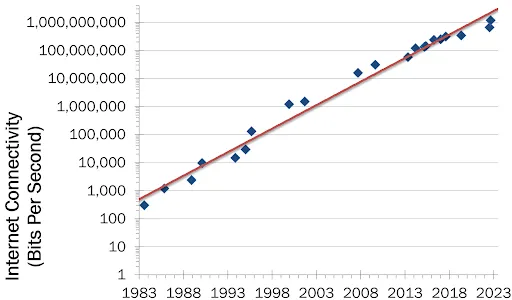
Historically, technology advances consistently raise bandwidth demands, a trend that shows no sign of slowing.
Nielsen’s law of internet bandwidth states that a high-end user’s connection speed grows by 50% per year as shown below.
2. Technology Equipment & Systems
These core network components are necessary for all of the endpoint technologies to work as planned. In some cases, an owner may have the technical human resources inhouse to define many or most of the required systems. In other cases, an owner might need assistance. Where assistance is needed, an experienced technology consultant can assist with definition and possibly procurement and implementation oversight of the required systems. These systems most often reside in a technology room (MDF, IDF) and include systems such as routers, switches, firewalls, fiber optic links, VoIP servers, and uninterruptible Power Supplies.
3. Endpoint Technology
Whether via a cable directly or by relying on wireless connectivity, this is the technology that most people are familiar with. Some are installed as part of the facility, while others might be technology brought into the facility by visitors, students, employees or guests. Access Control and CCTV systems are examples of installed systems. Examples of systems carried into the facility are cell phones and iPads.
Every industry now depends on technology systems for the effective and efficient operation of the business. And reliable technology is imperative for the functionality and convenience of employees, students, residents or visitors. Every one of those technologies require a well designed structured cabling system. And a well designed system requires expertise.

The job of the technology consultant is to provide the design for a structured cabling system which employs the best available technologies to achieve an owner’s objective, within budget. Knowing the most current individual systems and components is an important part of implementing the owner’s vision. It is equally important to understand the OSI model, which has been around since the 1980s.
The OSI model remains the foundation of a highly reliable structured cabling system. Just because technologies have advanced doesn’t mean that the foundations for the technologies have changed. NTI works to provide standards based designs as a way of creating a strong foundation for change and growth over time.NTI has successfully accomplished this for over 2,000 projects since 1998. This is why we believe that the best way to future proof the low voltage as much as possible is to employ a technology consultant with the required expertise.